
Combining styles with a spouse or significant other can be a fun design project. It can also lead to frustration and anger. A sentimental piece suddenly becomes a flash point for a heated argument. And what makes it sentimental? The first armchair they bought for their college apartment isn’t maybe as sentimental as your grandmother’s buffet that she used every Christmas.
Subscribe to the Behind the Shade MN Newsletter here.
This is something I was musing about on the Behind the Shade MN Substack newsletter recently. So I came up with some suggestions that have worked for me and along with a few other ideas. Hope this helps you create the weird, wonderful, and colorful (or not) space of your dreams.

I may have mentioned that I have a penchant for chandeliers. I found this one on Facebook Marketplace, and I paid for it. Please excuse the stained glass that is hung just a smidge too high.
Pay for it
You’ve got your heart set on a new rug for the living room, but your significant other thinks the one you have is “just fine.” And while the rug might be “just fine,” you’re sick of looking at it. One strategy I’ve found that works is to offer to pay for it. If it isn’t your significant other’s money being spent, you might find that they’re suddenly much more agreeable to a new rug. Of course, this won’t work for all design decisions (you’re probably not financing a gut-renovation of the kitchen on your own), but it certainly can be a great motivator and decision-maker for some of the smaller things that may feel big to you.
Give them a few options
Dying to try wallpaper in the powder room? Pick out 3 options, and then let your partner pick their favorite. Want a new faucet for the kitchen? Same strategy. Obviously, you’ve already decided you like all the options you’re presenting to your partner, but by letting them make the final choice, the decision become more theirs. Also, if they decide they hate it, they can only blame themselves (kidding, kinda).
Do the work
Want to paint your living room a moody, deep blue? Offer to do all the work yourself, which includes the prep work, the painting, and the cleanup when you’re done. Try to do it when your significant other isn’t around to minimize the inconvenience. If the project still feels too big to do on your own, enlist a sympathetic friend or family member to help with your passion project.
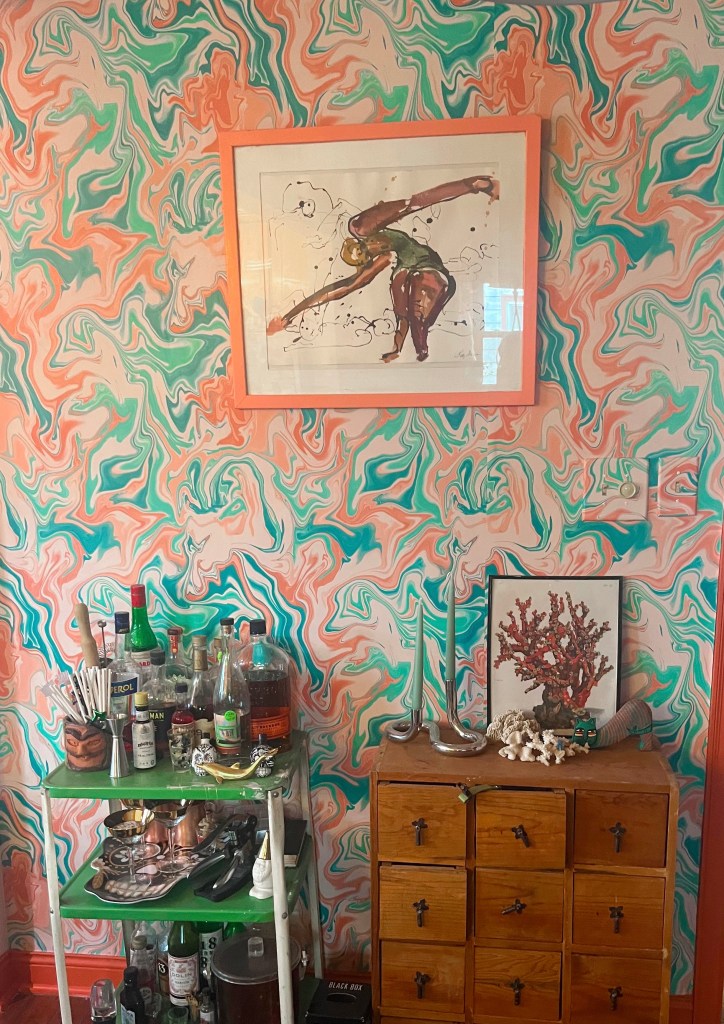
This wallpaper marks multiple strategies. I gave him several options, paid for it, and hung it myself. Wallpaper is from Spoonflower and original artwork is from Minnesota artist Kathy Mommsen.
Find a color you agree on
Color can be a divisive issue. Maybe you love beige, but your partner is all about bright colors. When you move in with someone, compromise is important. While you might like beige, perhaps what you really prefer is more muted colors, so try to find a muted version of the bright colors your partner enjoys.
On Emily Henderson’s website, writer & designer Caitlin Higgins suggests, “If you’re feeling hopeless, start with a color palette: Internally, the EHD team jokes that this is ‘the green effect,’ because it’s the shade that most cohabitating couples lean towards for their first place.” Green is a popular color right now, and there are many shades and tones to choose from.
I have also fallen for the green effect. I have a gorgeous, pink velvet headboard that I love. When I moved in with my significant other, there was no question it was going with me. Green is a complementary color to pink, so it was a natural choice to paint the bedroom. I found a great olive green, and we color-drenched the entire bedroom, walls and ceiling. It pops perfectly off the pink of the headboard, and the space is super cozy.
Pro-tip: I feel like everyone knows this, but I’m always surprised to encounter people who don’t. If you fall in love with a paint color from Benjamin Moore, Dunn-Edwards, Little Greene, or another paint brand, you can take that swatch to wherever you like to buy paint and have them color match it. You don’t have to pay designer paint prices to get designer paint colors. Likewise, you can take in a piece of fabric or other item, and they scan it (must be big enough to scan) and color match it. This *can* work with images, as long as you don’t take in glossy photos (I’ve learned this the hard way).
Pick a vibe
Another suggestion from writer & designer Caitlin Higgins, “Instead of focusing on your specific styles, pick a few words that’ll capture the energy of your finished space. Trying to design a space that’s a perfect 50/50 representation of each person is tough – it’s much easier to work together when you’re both focused on the vision of a ‘warm, cozy, collected, and colorful’ home.” Most of us want a home that feels comfortable; cozy is also a wonderful way to have a space feel.
Perhaps you’re a creative, and you want your home to feel inspiring? Inspiring is different than saying you want bright colors, so that’s another way to bring together your styles and figure out how to merge them. Make sure the words you choose describe more of a feeling or energy, rather than specific styles like maximalist, minimalist, bohemian, mid-century modern, etc.
Find yourself a compromise cabinet™
I mentioned the compromise cabinet™ in my Substack newsletter a few weeks ago. My partner and I were having a disagreement on the Ikea Kallax cabinet that stored his records and another Ikea cabinet storing his record equipment. I wanted something more attractive and better built. He thought it was “just fine,” and it stored all his records well. After shopping, both online and in person, he found a free cabinet in the alley. It wasn’t exactly what I had in mind, to be honest.
It also wasn’t quite big enough, so we had to add another layer to fit more records. Since he had found it for free* and picked it out*, I chose the colors to make it bright and fun, though I did show him the colors before I painted. I also added the fanciest knob from Sazerac Stitches to the cabinet. To house his record player and other equipment, we found a cool burl veneer cabinet from the thrift store. This cost $50.
Though the compromise cabinet™ wasn’t what I had envisioned, it is certainly an upgrade, and the color and design gives me a lot of joy. It also houses his records and has room for pretty things too. And I like it much, much better than the black Kallax cabinet.
Discuss the no-go’s
There are some design choices that you likely can’t stand. For me, it’s those overstuffed couches, often in practical beige or tan, with the built in drink-holders. These couches may be cozy, but to me, these couches are personality-less blobs, the shapeless khakis of the furniture world.

A couch like this gives me the yawns. Photo by Chelsea Fern on Unsplash
You and your significant other should sit down and make a list of items or designs that are no-go’s for your shared space. The list doesn’t need to be long (and hopefully it’s not or your process just got a lot more complicated). Then simply avoid these design no-go’s.
Bonus tip: My partner also suggested chocolate as a negotiation tactic. If your significant other really loves chocolate, this COULD be a good persuasion tool.
 Behind the Shade MN
Leave a comment